While they range considerably in terms of comfort and support, hospital bed mattresses usually come in one of four different types.
Innersprings aren’t only one of the least expensive hospital bed mattresses you can buy, they’re also the option you’ll likely be the most used to because of their similarity to traditional mattresses.
These mattresses are also often more supportive than other mattress types, such as foam.
An Innerspring hospital bed mattress is made up of evenly distributed coils, which significantly increases airflow and makes for cool, dry, and comfortable sleeping.
This is crucial if you’ll need to spend most of the day laying on the mattress, as proper airflow can help prevent ulcers from forming.
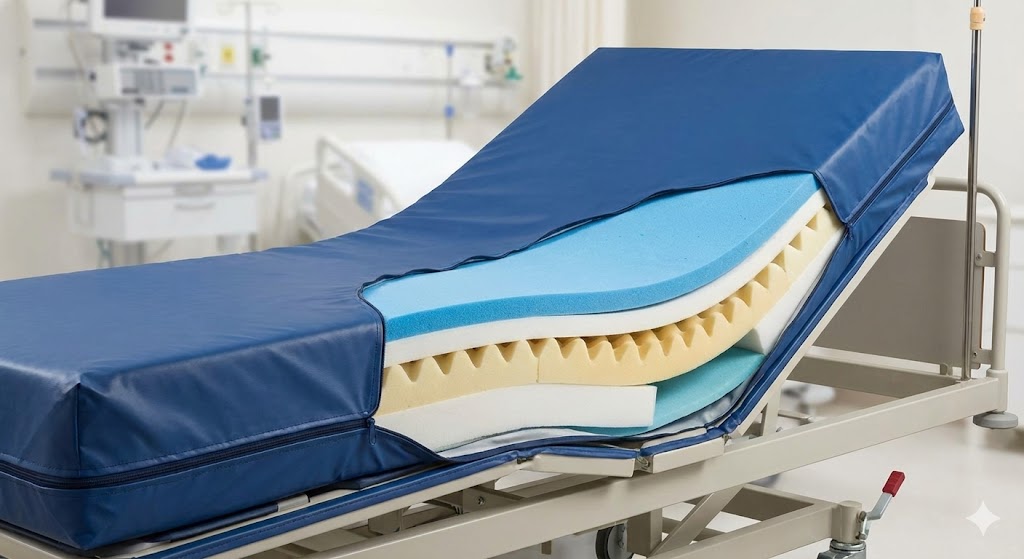
Like Innersprings, a Foam hospital bed mattress is generally less expensive than other medical bed options.
They typically also weigh less than other types, which can be a big plus if you’re setting one up on your own.
This type of mattress is usually made up of layers of foam that act to “cradle” your body, adding to the comfort level and lowering the risk of back pain or pressure ulcers.
On the downside, a Foam mattress will usually offer less airflow and overall support when compared to other mattresses.
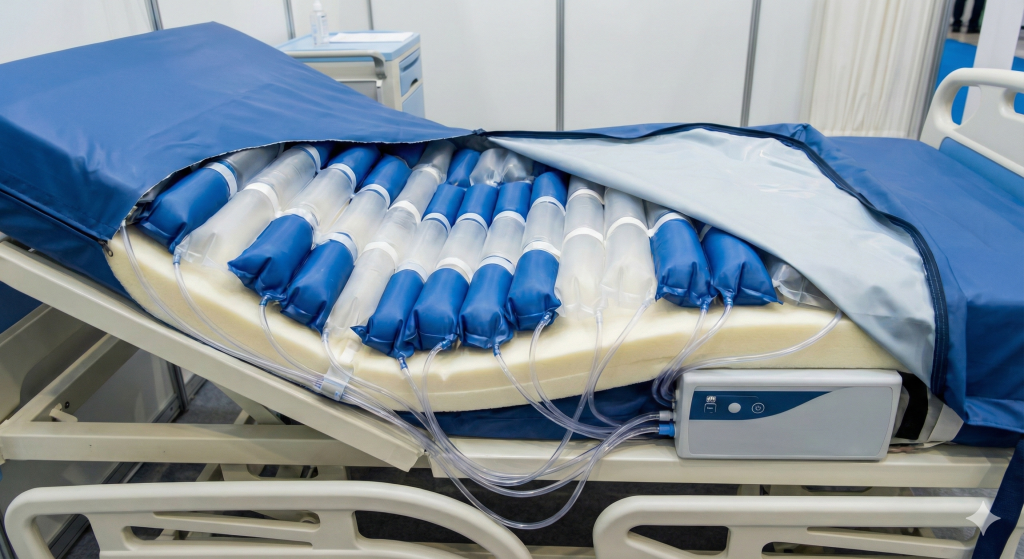
An alternating pressure hospital bed helps to limit the occurrence of pressure ulcers by constantly — and slowly — inflating and deflating air bladders within the mattress.
Positioned either lengthwise or across, these bladders present a consistently changing surface to keep pressure from building that can lead to bedsores.
This type of therapeutic mattress is also used to help heal pre-existing pressure ulcers, and the changing pressure levels help to keep body fluids and lung secretions circulating, which can be a big help for those who cannot reposition themselves in the bed.
However, a hospital bed mattress of this type can be considerably more expensive than one made from innersprings or foam. These mattresses also require a power source and a motor or pump, which may interrupt the sleep of light sleepers.
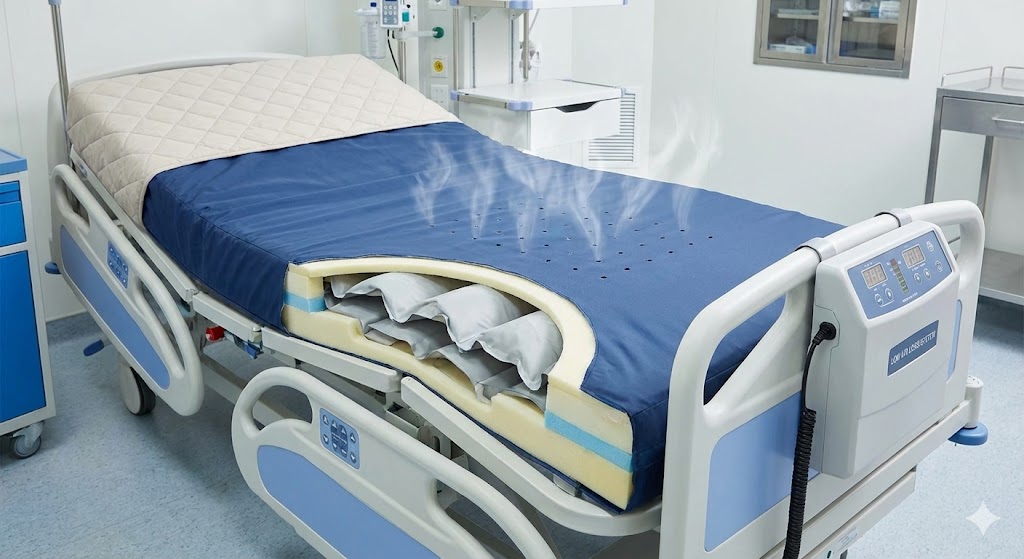
Also known as “low air loss mattresses”, air jet hospital bed mattresses are constructed with laser-drilled holes so that air is constantly blowing up and out.
This has two primary functions:
Much like alternating pressure mattresses, air jet hospital bed mattresses are more expensive than other types of medical bed mattresses and can be loud due to their motor and pump.
Mattress Insider’s 6” Hospital Bed Mattress is made up of 6” thick high-density foam, and is covered with an easy-to-clean blue nylon fabric cover.
This mattress measures a standard 80” x 36”, although you can also purchase it in a variety of other sizes.
It sells for $249, and includes free shipping and a 121-night satisfaction guarantee.
The Therapeutic 5 Zone Support Mattress is made up of five unique zones that can help to evenly distribute a person’s weight.
This foam hospital bed mattress is both waterproof and flame retardant, and works best for either stomach or back sleepers. It sells for around $160.
The Ortho-Coil Super Firm Support Innerspring Mattress is a hospital bed mattress that offers maximum support for those weighing up to 350 pounds.
This mattress features good airflow, easy cleaning, and fire-resistance. Due to its “super” firmness, this is not the best option for those who are bedridden, as it isn’t designed for preventing or healing pressure ulcers.
This Innerspring hospital bed mattress fits standard-sized hospital beds and includes a one-year warranty. It sells for around $375.
Comfort Zone offers one of the best low air loss mattresses available.
This medical bed mattress features forty air cells in a 20 x 20 grid design, making individual cells easy to replace if they fail. It’s also customizable to a patient’s weight (up to 400 lbs.), and can be set to a variety of timed cycles to accommodate a patient’s specific needs.
This therapeutic mattress is water-resistant and easy to clean, and special features include a low-pressure pump alert.
The Cell-On-Cell Low Air Loss Mattress includes a two-year limited warranty and starts out around $560.
Do you suffer from an unreliable power grid? Invacare’s microAIR MA500 Alternating Pressure Low Air Loss Mattress features a cell-in-cell design to hold up during power failures, and an audio/visual alarm system to let you know when the power is out.
This hospital bed mattress features eight adjustable comfort settings, easy cleaning, and includes a cable management system to prevent tripping when getting in and out of bed.
It sells for around $650.
Our team of real people is here to help!
We here at Mattress Insider offer both hospital bed mattresses and specialized hospital bed toppers.
HomecareHospitalBeds.com and even Amazon.com also sell hospital bed mattresses. Or, if you’d prefer to shop locally, mattress and bedding stores in your area should stock hospital bed mattresses, as should larger box stores such as Walmart.
Here’s another tip: Before shopping for a hospital bed mattress, contact your health insurance agent or Medicare to find out if the mattress will be covered, as well as what procedures you will have to follow for reimbursement.
(Something like Medicare will often cover a mattress as a durable medical device, but you’ll usually be required to submit a receipt.)
Investing in something like a low air loss or alternating pressure hospital bed mattress will most likely make the person more comfortable and help to keep health issues such as pressure ulcers from forming.
A standard feature of most hospital bed mattresses is their ability to flex — especially in the head and leg area.
Hospital beds are designed to flex so that the patient can achieve a variety of positions, such as sitting up. This can help to distribute weight and prevent pressure ulcers.
Generally, a hospital bed mattress should be both waterproof and easy to clean. Plus, if the mattress is antimicrobial, all the better!
While it will not always be possible, if you can, have the person who will be using the hospital bed mattress try it out before purchasing.
People usually have different preferences when it comes to a mattress’s support and comfort, and when you throw in ailments or aging issues, one person’s perfect hospital bed mattress will be another’s nightmare.
Hospital bed mattresses are typically designed to fit a traditional hospital bed. The majority of hospital bed mattresses as such are 80” x 36”, or Twin XL sized.
Measure carefully, however, as some hospital beds — such as bariatric beds — use a larger hospital bed mattress.
Hospital bed mattresses usually have a weight capacity of somewhere between 300 and 450 pounds, although those designed for bariatric beds will often have a higher capacity.
If you feel that weight will be a big consideration, carefully note what the hospital bed mattress’s maximum capacity.
Some experts believe that silk-based fabrics can cause less friction damage than cotton-based ones.
If you fear that pressure ulcers will be an issue, consider narrowing your choices down to those using silk-based fabrics.
Mattress toppers made with a layer of gel, air, or foam can help improve blood circulation and prevent pressure ulcers.
For an easy comfort add-on to your hospital bed mattress, consider one of these overlays.
Hospital bed mattresses can range anywhere from $100 up to several thousand dollars, and what you spend will often depend on what type of mattress you need.
If you want to spend less, consider going with an Innerspring or foam hospital bed mattress.
Innerspring hospital bed mattresses typically sell in a wide range of different qualities, and their price range, $100 to $400, reflects this.
Foam hospital bed mattresses will usually cost between $175 and $300.
Alternative pressure pads and air jet hospital bed mattresses will generally be more expensive based on their more complex design, and the fact that they include a motor and pump.
These hospital bed mattresses start out at around $300 and can reach as high as several thousand dollars.
When budgeting for a hospital bed mattress, there are several other factors to consider which can help to either save you money or protect your investment. If you are purchasing your therapeutic mattress online, you should know if the site includes free shipping (most sellers do) and how long it will take to ship to your location.
You should also inquire as to what types of delivery options, such as White Glove services and free mattress removal, are included. Gathering information concerning warranties, returns, and trial periods should be on your to-do list as well, when shopping for any of the various types of hospital bed mattresses.
Investing in something like a low air loss or alternating pressure hospital bed mattress will most likely make the person more comfortable and help to keep health issues such as pressure ulcers from forming.
The best mattress for a hospital bed (also known as a therapeutic, geriatric, or medical mattress) is one that is both supportive and comfortable. Patients will be laying on them for extended times, and they need a mattress that has both support and comfort factored into the construction of the bed.
Generally speaking, a regular mattress should not be used for a hospital bed. Many home mattresses do not offer the same support and many can cause pressure on uncomfortable places in the body. In some cases, this can contribute to bed sores. Additionally, hospital beds often need a cover that is easily cleanable and fluid proof.
A standard 1.5 lb, 6” polyurethane foam hospital mattress will support up to about 230 lbs.
While most hospital mattresses range from $500 to $1000, Mattress Insider specializes in making less expensive, though still high quality, options.
18 scientifically proven tips
(for 2025) that you can use tonight.