The best mattress to prevent snoring

Can a bad mattress cause snoring?

Yes! The right mattress is absolutely necessary to avoid bad (or no) support that leads to snoring and health issues such as back, neck, hip, or shoulder pain. 

The wrong mattress not only worsens your snoring, it can also cause back pain, trigger allergies, and lead to poor sleep.

Start getting REM sleep with the right mattress

The right balance of supportive and comfortable is essential to achieve great spinal alignment, and different mattress materials offer different options.

Innerspring mattresses

Innerspring mattresses can reduce snoring because they offer good firmness and support to align the spine.

They’re made with individually-wrapped coils (advanced coil technology) that works great to maintain healthy sleep posture and relieve back and neck pains. Encased coils move independently when the body moves, so they provide support where it’s needed to keep the spine aligned throughout the night.

Latex mattresses

Latex mattresses are super supportive and great at helping maintain spinal alignment while a person sleeps, reducing the chances of snoring. However, they don’t offer much pressure point relief unless a foam top is added. 

This is an essential consideration for side sleepers who need added softness for their shoulders and hips.

Latex mattresses are made using latex foam. To be a true latex mattress, all layers of the mattress must be made of latex with no other types of foam or coils included in the mattress structure.

Memory Foam mattresses

Memory Foam mattresses provide great support and contour to the body to align the spine, making snoring less likely. They adapt to the body’s shape, so weight is distributed evenly among pressure points.

  • People with a heavier body weight do well when selecting a Memory Foam mattress with multiple, dense layers of foam, as the mattress is firm enough to align the spine for better posture.

  • Stomach sleepers also do well with a firmer Memory Foam mattress.

  • Lighter body types, side sleepers, and back sleepers can choose a softer option to get the best effects of contouring for spinal alignment and pressure point relief for the hips and shoulders.

Hybrid mattresses

Hybrid mattresses include one or more layers of Memory Foam and an Innerspring layer. The former provides contouring, while the latter provides adequate support to keep the spine aligned and keep you from waking up the neighbors. 

The firmness and cushioning vary based on the specific mattress, so Hybrids make an excellent choice for all sleeping positions and body types.

Can your sleep position make you snore?

Sleeping on your back

Sleeping on your back is super beneficial for many reasons. Not only does this position help keep your spine aligned, but it can also help reduce neck and back pain, prevent tension headaches, and improve breathing.

But, and it’s a big but, sleeping on your back can sometimes lead to snoring or even cause your airway to completely collapse (i.e. sleep apnea). 

This is because when you sleep on your back, the base of your tongue and soft palate relax to the back wall of your throat. This in turn narrows your airway and leads to snoring.

Sleeping on your side

Unlike sleeping on your back, which narrows or closes your airway, sleeping on your side can do wonders for your snoring and your overall health. 

Sleeping on your side prevents your tongue and soft palate from relaxing or collapsing to the back of the wall, which is important for keeping your airway open.

Not only does this reduce snoring but it also ensures your breathing isn’t interrupted or momentarily cut off. In fact, sleeping on your side is considered the best sleeping position for preventing snoring.

Sleeping on your stomach

Generally speaking, sleeping on your stomach isn’t recommended as it’s not the best position for overall health and can lead to neck, shoulder and back pain.

However, John Hopkins Medicine and others state that sleeping on the stomach can reduce snoring and help with sleep apnea.

sunset-mattress
comfy-mattress-at-sunset

Additional products for snoring relief

A mattress alone isn’t the only way to get relief from snoring. In addition to your mattress, you can increase your chances of reducing or eliminating snoring with these anti-snoring products.

Pillows

Did you know there’s such a thing as “anti-snoring pillows”?

Anti-snoring pillows are designed to provide additional support for your neck and head, keep your airway open and promote spinal alignment. The great thing about anti-snoring pillows is that they offer different support and firmness levels as well as different sizes and shapes.

Mattress toppers

A mattress topper is great option to increase comfort and improve spinal alignment.

Our custom Brookside memory foam topper with organic cotton option, as it provides maximum pressure point relief and in turn will ease neck or shoulder tension and reduce snoring.

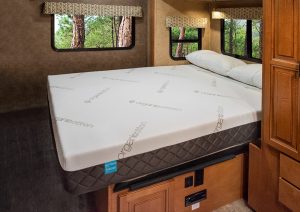
And if you’re often on the road with your RV or truck or on water with your boat, then you’ll love our 3 LB Gel Custom memory foam mattress topper! Offering all the same benefits, it’s a great option for making your night-time breathing easier.

Humidifiers

A humidifier can help with snoring if your snoring is due to dryness in your nose, sinuses, and throat. This can happen when you live in a dry climate. 

A humidifier is a device that emits steam or water vapor into the air to increase moisture. With moisture in the air, it becomes easier to breathe.

Air purifiers

Did you know that according to the Environmental Protection Agency, indoor air is 2x to 5x more polluted than outdoor air?

And poor air quality is linked to many health issues including — you guessed it! — snoring.

The good news is that you can minimize the risks associated with poor air quality by using an air purifier.

Continuous positive airway pressure (Cpap) Machine

Though not everyone who snores has sleep apnea, snoring is a very common symptom of this disorder.

If you have sleep apnea, a CPAP machine can help by delivering a constant flow of pressurized air to your airway. This constant air pressure helps keep your airways open so that you snore less, and sleep better.

Nasal strips

Designed for those who snore due to a blocked nose, nasal strips offer a promising solution. Nasal strips are plastic adhesive strips that are worn over the bridge of the nose, which can increase airflow and thus help reduce snoring.

While nasal strips don’t cure snoring, especially if there’s an underlying cause, they are an affordable and noninvasive way to reduce snoring.

Nasal dilators

There are two types of nasal dilators: external nasal dilators that pull from the outside (like the nasal strips above), and internal devices that push from the inside.

If your snoring is caused by a blocked or narrow nasal airway, nasal dilators could help by opening the nostril or nasal passage to improve airflow through your nose.

In a comparison study, researchers found that internal nasal dilators such as those from Nas-air® worked better than external ones (from Breathe Right®) at reducing snoring and improving overall sleep quality.

Mouthpieces

Also called mouthguards, mouthpieces can be helpful in reducing snoring. There are two categories of mouthpieces: Mandibular advanced devices (MADs) or Tongue retaining devices (TRDs).

MADs, are designed to fit inside the mouth and move your jaw forward while you sleep. This position helps open up your airway so you can breathe better and in turn, snore less.

The second category, TRDs, is designed to hold the tongue forward (hence the name, tongue retaining device!) during sleep so it doesn’t block the airway. This is important as the tongue falling into the back of the throat is common for back sleepers who snore.

Decongestants or antihistamines

Nasal congestion due to colds or allergies is one of the most common reasons people snore. 

If your snoring is allergy induced, what you need is something that can help with your congested nose. Two of the most common ones that can help are decongestants and antihistamines.

Have Questions?

Our team of real people is here to help!

inviting-bed-sepia

FAQ

Can your sleep position make you snore?

Yes, the sleep position most prone to snoring is on your back, while the least prone is on your stomach.

Can a bad mattress cause snoring?

The right mattress is absolutely necessary to avoid bad (or no) support that leads to snoring and health issues such as back, neck, hip, or shoulder pain.

soft-bed-afternoon
Get Your 100% Free Guide
How to Sleep
Through The Night

18 scientifically proven tips
(for 2025) that you can use tonight.

Want Something Even Better? Join Now To Unlock Your 8% Off Coupon. Code Delivered Via Email. Sweet Dreams + Savings Guaranteed!